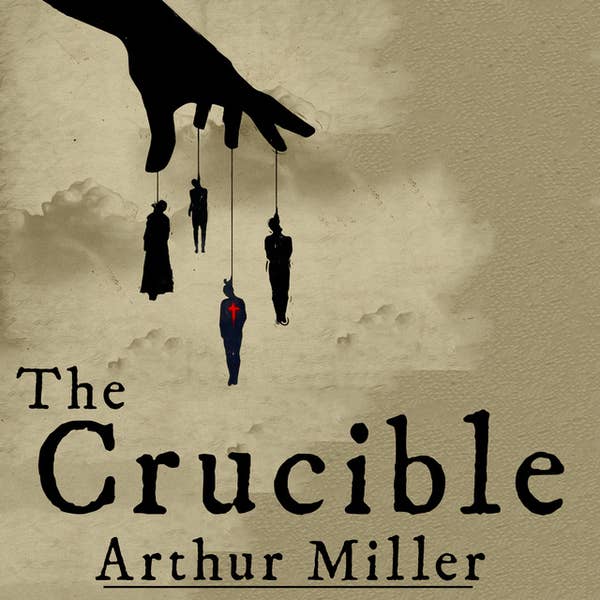
The Crucible Summary
Arthur Miller • Tragedy, Historical Drama
The Crucible by Arthur Miller – Act 1 Summary, Characters, and Analysis
The Crucible by Arthur Miller is a powerful historical drama that explores mass hysteria, moral integrity, and the destructive force of fear. First performed in 1953, the play is set during the Salem witch trials of the late 17th century and uses this historical event as an allegory for political persecution and paranoia. This article provides a detailed book summary, an overview of the main characters, and a critical analysis of The Crucible, focusing on its themes, symbolism, and historical significance.
Below, you will find a crucible summary that covers the key plot points, themes, and character developments in Act 1.
Book Summary of The Crucible by Arthur Miller
The Crucible is set in Salem, Massachusetts, in 1692, a rigidly religious Puritan community governed by strict moral codes and a deep fear of sin. The play opens in the Parris household, where Reverend Parris, the town minister, discovers his daughter Betty Parris unconscious after she and several other girls—including Mercy Lewis and Ann Putnam—were caught dancing in the forest, an act considered sinful. Rumors of witchcraft quickly spread, threatening the social and religious stability of the Salem community.
To avoid punishment, the girls—led by Abigail Williams, Parris’s niece—begin accusing others of witchcraft. Abigail threatens the other girls to maintain their silence. Abigail, manipulative and intelligent, uses the hysteria to gain power and settle personal grudges. Her accusations escalate rapidly, as the court begins arresting and interrogating citizens based on spectral evidence and public testimony. Rebecca Nurse, a respected figure, is also accused as the hysteria grows.
At the center of the conflict is John Proctor, a respected but flawed farmer who previously had an affair with Abigail. Proctor is deeply troubled by the unfolding events and recognizes the danger of false accusations. His wife, Goody Proctor (Elizabeth), is arrested after the girls accused Elizabeth, Proctor's wife, of witchcraft in an attempt to remove her rival and regain influence over John. Ezekiel Cheever, a court official, comes to arrest Elizabeth, and Sarah Good is another woman accused. Mary Warren, their servant, intervenes and claims she saved Elizabeth's life. Mary tells the court about the girls' actions, but the hysteria continues.
As the trials intensify, fear overtakes reason. Neighbors turn against one another, and accusations become tools for revenge, greed, and self-preservation. The court, led by Judge Danforth, refuses to question the legitimacy of the proceedings, believing that to do so would undermine its authority. Francis Nurse, Giles Corey, and Martha Corey are drawn into the trials. Giles refuses to name witnesses, and the girls accuse George Jacobs, leading to his arrest. Confessions are posted on the church door as a public display of repentance. Those who confess are spared, while those who maintain their innocence face execution in the Salem jail cell.
John Proctor attempts to expose Abigail’s lies by admitting his adultery in court—Proctor confesses and Proctor reveals his affair, hoping to discredit her motives. However, when the court questions Proctor and calls Elizabeth to test Proctor's claim, Elizabeth denies the affair to protect her husband, resulting in a tragic misunderstanding that strengthens Abigail’s position. Despite mounting evidence of deception, the court continues its course, valuing public order over truth. Proctor brings Mary to court to expose Abigail, but Abigail denies the accusations and manipulates the proceedings. Proctor cries out against the injustice and reprimands the court for its blindness.
In Act III and Act IV, Proctor is arrested and pressured to confess to witchcraft. Though he initially agrees to save his life—Proctor agrees to confess—he ultimately refuses to sign a false confession that would be displayed on the church door. Proctor refuses to sacrifice his integrity, even as Hale begs Elizabeth to persuade him. Proctor accepts death, asserting the importance of personal conscience and moral truth. Hale quits the court in protest of the injustice.
The play ends with Proctor’s execution and Elizabeth’s quiet recognition of his moral redemption, while Salem remains scarred by fear, injustice, and irreversible loss. Miller wrote the play as an allegory for the McCarthy trials, highlighting the dangers of mass hysteria and the breakdown of justice in the Salem community.
Main Characters in The Crucible by Arthur Miller
John Proctor
A farmer who serves as the play’s moral center. Proctor struggles with guilt over his past mistakes but ultimately chooses honesty and integrity, even at the cost of his life.
Abigail Williams
The primary antagonist. Intelligent, manipulative, and driven by desire and resentment, Abigail exploits the witch trials to gain power and control over others.
Elizabeth Proctor
John’s wife, known for her honesty and moral strength. Her journey reflects forgiveness, restraint, and quiet resilience.
Reverend Samuel Parris
The paranoid and self-serving minister of Salem. His concern for reputation over truth contributes to the escalation of hysteria.
Deputy Governor Danforth
The rigid authority figure of the court. Danforth represents institutional power and the danger of absolute certainty.
Mary Warren
A member of Abigail’s group who struggles between truth and fear. Her weakness illustrates how hysteria thrives on intimidation.
Analysis of The Crucible by Arthur Miller
Major Themes
Mass Hysteria
The play demonstrates how fear spreads rapidly within closed societies, overwhelming logic and justice. Once hysteria takes hold, reason becomes powerless.
Integrity and Moral Choice
John Proctor’s refusal to lie underscores the importance of personal integrity. Miller emphasizes that moral courage often requires personal sacrifice.
Power and Authority
The court’s refusal to reconsider its actions reveals how institutions prioritize control over truth. Authority becomes self-protective and destructive.
Reputation and Identity
Characters are obsessed with their public image. Reputation becomes a form of social currency, influencing decisions and moral compromise.
Symbolism and Literary Devices
- The Crucible itself symbolizes intense pressure that exposes true character.
- The Forest represents freedom, chaos, and the unknown, contrasted with rigid Puritan order.
- Confessions function as tools of control rather than truth.
- Allegory connects the Salem trials to McCarthyism and political persecution in 1950s America.
Miller’s straightforward dialogue and escalating tension reinforce the sense of inevitability and moral urgency.
Author Background and Historical Context
Arthur Miller was an American playwright who wrote The Crucible during the era of McCarthyism, when accusations of communist affiliations destroyed careers and lives. By dramatizing the Salem witch trials, Miller critiqued contemporary political repression and the dangers of ideological extremism.
The Crucible by Arthur Miller: Impact and Legacy
The Crucible is considered one of the most important plays in American theater. It remains widely studied for its historical relevance, moral complexity, and powerful warning about the consequences of fear-driven societies.
Who Should Read The Crucible by Arthur Miller
- Readers interested in historical drama
- Students studying American literature or theater
- Those exploring themes of justice, power, and morality
- Anyone interested in political allegory and social critique
Level up your reading with Peech
Boost your productivity and absorb knowledge faster than ever.
Start now